

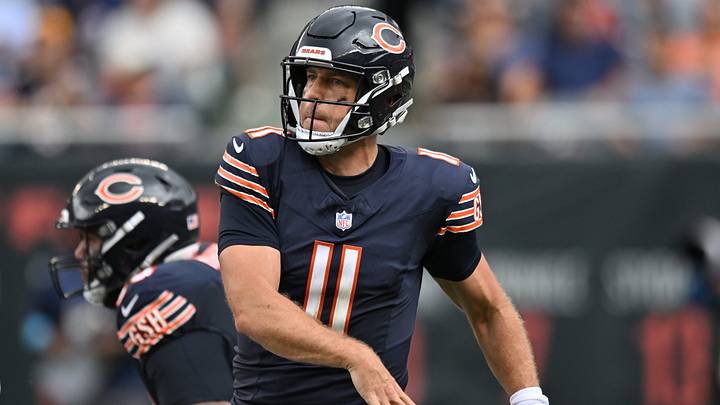
The Bears beating Cleveland 34-10 did not require much explanation by the fourth quarter. One team kept scoring, the other had apparently seen enough.
How Chicago got there was far more unusual. The Bears lost the possession battle, struggled on third down and allowed Cleveland to cross midfield throughout the afternoon. Somehow, none of those problems damaged the final product.
These three numbers explain why.
Bears needed only 12:46 to score 34 points
Chicago’s six scoring drives lasted a combined 12 minutes and 46 seconds. Four were over in less than two minutes.
The first touchdown required four plays and 1:31. The Bears opened the second half by traveling 78 yards in 1:55, with Case Keenum finding Salvon Ahmed for a 49-yard score. Another seven-play touchdown drive took 3:46.
Case Keenum (1) to Salvon Ahmed (1)*
— NFL Touchdown Videos (@NFLTDsVideos) August 15, 2026
Chicago Bears
49 yards pic.twitter.com/QfIj9fI3fK
Even the backups’ backups joined in. Miller Moss led a 70-yard touchdown drive late in the fourth quarter after Chicago started at its own 30.
Cleveland held the ball for 34:03, nearly nine minutes longer than Chicago. The Browns also ran one more offensive play. Normally, those numbers suggest the winning team controlled the afternoon.
Not this time. The Bears just made better use of their turn.
Four third-down conversions somehow produced 430 yards
The Bears converted four of their 12 third downs. Not exactly a solid conversion rate.
Chicago still gained 430 yards and averaged 6.8 yards per play.
The offense kept producing large gains before third down could become a problem. Six Bears finished with at least 34 receiving yards. Chicago completed passes covering 49, 41, 28, 25 and 22 yards, with Tyson Bagent and Keenum responsible for most of the damage.
There is a warning hiding inside those numbers. Big plays are wonderful until a defense takes them away. Regular-season starters will close space faster, and coordinators will bring considerably more than the plain oatmeal served during preseason games.
Chicago will eventually have to convert third downs instead of avoiding them. Against Cleveland, avoiding them worked just fine.
Seven trips across midfield produced only 10 points
Cleveland moved the ball far more frequently than the score suggests. The Browns crossed midfield on seven possessions and made three trips into the red zone.
They scored 10 points all afternoon.
Chicago’s defense was hardly airtight. Cleveland found room early, built a 10-0 lead and controlled possession. The Bears simply refused to let those yards turn into anything useful.
The Browns went 1-for-3 in the red zone and failed on two of three fourth-down attempts. One of those stops came at Chicago’s 5-yard line. Their final nine possessions produced two interceptions, a lost fumble, four punts, a turnover on downs and the end of the game.
Beanie Bishop Jr. supplied both interceptions. Jamree Kromah forced the fumble and recovered it himself. Cleveland repeatedly reached promising territory and then discovered a new way to leave without points.
Beanie Bishop Jr. gets his second INT of the second half!
— NFL (@NFL) August 15, 2026
CLEvsCHI on @nflnetwork
Stream on @NFLPlus pic.twitter.com/Go16Qf6g2a
Yes, it was an August game with stars resting and coaches protecting the useful sections of their playbooks. Nobody should begin planning a parade route.
Still, Chicago won the parts of the game that changed the score. Cleveland won time of possession. The Bears probably will not demand a recount.
| More Bears on DaWindyCity |
 Add us as a preferred source on Google