

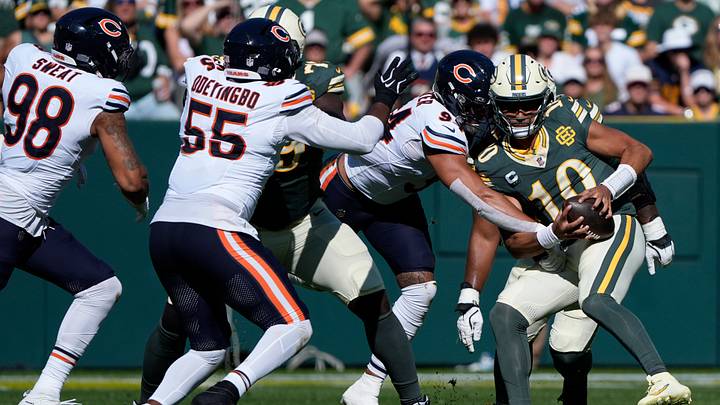
For three weeks, the Chicago Bears had people believing their defense was finally turning a corner. Opposing offenses weren't scoring much, Chicago was winning games, and there was reason to think the team had found something it could build around.
Then Green Bay put 31 points on the board.
The Bears' 31-7 loss on Sunday wasn't simply a bad afternoon against a division rival. It exposed a problem that had been easy to overlook during Chicago's three-game winning streak. The defense looked good on paper, but how much had it actually improved?
The Bears' defensive numbers weren't telling the whole story
Chicago allowed just 28 points over its previous three games. That's impressive no matter how you slice it, and the defense deserves credit for doing its part during that stretch.
Still, there's a difference between keeping opponents off the scoreboard and controlling what they're able to do offensively.
Green Bay found that difference rather quickly.
The Packers attacked downfield and made Chicago pay for breakdowns in coverage. Instead of forcing Green Bay to put together long drives, the Bears allowed explosive plays that made life considerably easier for the opposing offense.
And that's where the concern begins.
A defense doesn't have to shut down every opponent to be successful. Nobody expects that. But when an offense can pick up large chunks of yardage without much resistance, the rest of the defensive statistics become considerably less impressive.
Chicago had spent three weeks making life difficult for opposing offenses. Green Bay made it look far too easy.
Chicago needs more than takeaways to win consistently
Turnovers can completely change a football game. The Bears know that better than most teams, having benefited from timely takeaways throughout their recent success.
But there's a problem with building too much of your defensive identity around them.
You can't count on getting three turnovers every Sunday.
Look at what Chicago did against Philadelphia on September 28th. The Bears forced three turnovers, held the Eagles to two third-down conversions in nine attempts, and allowed only 62 yards in the second half.
That's the kind of defensive performance that should give Bears fans confidence.
Chicago didn't just wait around for Philadelphia to make mistakes. The defense made it difficult for the Eagles to accomplish much of anything.
That's what was missing against Green Bay.
The Packers didn't need to play a perfect game. They found weaknesses, attacked them, and kept going back to what worked. Chicago never found a consistent answer.
For a team hoping to compete for the NFC North, that's a problem worth addressing now rather than in December.
Getting Caleb Williams back won't fix the defense
Naturally, plenty of attention has gone toward Chicago's quarterback situation following Sunday's loss.
Caleb Williams remains sidelined with a hamstring injury, and Tyson Bagent struggled against Green Bay. Getting Williams back should help the offense, but it won't do much good if opponents can continue attacking Chicago's secondary.
The Bears aren't going to score 30 points every week. Even with Williams healthy, there will be afternoons when the offense struggles to move the ball.
That's when a good defense earns its reputation.
Chicago has shown it can make opposing offenses miserable. The performance against Philadelphia proved that. But the Packers exposed how quickly things can unravel when the Bears aren't generating turnovers or preventing big plays.
One bad game doesn't mean the defense is suddenly terrible. It also doesn't mean the previous three games should be forgotten.
What it does mean is that Chicago still has something to prove.
The Bears are 3-2, and there's plenty of football left to play. But if this team wants to be taken seriously as a contender, its defense needs to be more than a unit that looks impressive against certain opponents.
It needs to hold up against the good ones, too.
| More Bears on DaWindyCity |
 Add us as a preferred source on Google