

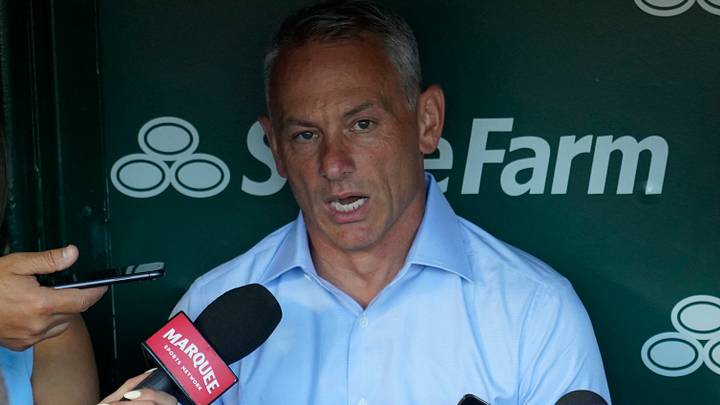
How many question marks can Jed Hoyer afford to have in one starting rotation?
That's something the Chicago Cubs need to figure out before spring training. The offseason is underway, and the list of pitchers they can confidently pencil into next year's rotation is awfully short.
The Cubs won 89 games in 2026. That wasn't enough to catch Milwaukee, and there's little reason to believe the gap will close if Chicago enters next season with an even shakier pitching staff.
Hoyer has some work to do. Quite a bit, actually.
Cubs' rotation has more holes than answers
Start with the free agents. Shota Imanaga, Matthew Boyd, Kevin Gausman, David Peterson, and Clay Holmes all entered the market.
Chicago isn't necessarily going to lose every one of them, but bringing everybody back isn't much of a plan, either.
Then there's the injury situation.
Ben Brown underwent neck surgery after putting together an impressive season. He finished with a 1.85 ERA over 68 innings, giving the Cubs reason to believe he could become an important part of their rotation.
Cade Horton is recovering from Tommy John surgery. Justin Steele hasn't pitched in the majors since April 2025.
And Edward Cabrera, who was supposed to help stabilize things, finished 2026 with a 5.96 ERA.
That's not exactly a group that inspires confidence.
Sure, Brown could return healthy. Horton could eventually pick up where he left off. Cabrera might rediscover whatever made Chicago interested in acquiring him.
But how many of those things need to happen for the Cubs to have a dependable rotation?
Probably more than Hoyer should be comfortable with.
Jed Hoyer needs to stop betting on everything going right
Nobody is suggesting Chicago should throw $200 million at the first available starting pitcher.
But the Cubs need somebody who can reliably give them innings without coming with a lengthy list of concerns.
Hoyer has done well finding value in the past. There's nothing wrong with that approach when those acquisitions supplement an established roster.
It's a different story when the entire pitching staff starts depending on bounce-back seasons and successful injury recoveries.
Chicago already has enough uncertainty. Adding another reclamation project and calling the rotation complete would be difficult to defend.
And the Cubs aren't rebuilding. They're supposed to be competing for a division title.
Milwaukee has given the Cubs another reason to spend
The Brewers just won the World Series, which makes Chicago's situation even harder to swallow.
Milwaukee has figured out how to build a pitching staff capable of winning championships. The Cubs are still trying to figure out who will be healthy enough to start games next April.
Hoyer has acknowledged the difference between the two clubs.
Fine. Now what?
The Cubs have money, a competitive roster, and a fan base that's tired of watching Milwaukee finish ahead of them.
They don't need to win the offseason. They need to come out of it with enough starting pitching to make a legitimate run at the division.
There's still time to make that happen.
But if Chicago enters spring training counting on three or four best-case scenarios, Hoyer shouldn't be surprised when the same old problems show up again.
 Add us as a preferred source on Google