

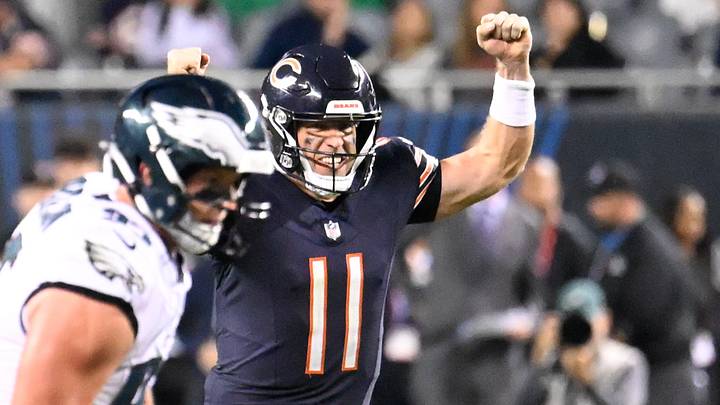
The Bears didn't need Caleb Williams to beat the Eagles on Monday night. They may have learned something that can help him when he returns.
Case Keenum's performance wasn't spectacular because he suddenly turned into one of the NFL's best quarterbacks at 38 years old. It was how quickly Chicago's offense operated with him behind center. Keenum got the ball out, handled pressure and rarely allowed Philadelphia's pass rush enough time to wreck a play.
Case Keenum showed what quicker decisions can do for Bears offense
Through his first two games, Williams was pressured on 47.1% of his dropbacks, the highest rate among qualifying quarterbacks. His average time to throw this season sits at 3.7 seconds.
Those numbers don't automatically make Williams responsible for Chicago's protection problems. Pressure can come from a missed block, a protection breakdown or a defense simply winning up front. But quarterbacks can create some of their own problems when they hold the ball.
Monday offered a pretty interesting comparison.
Keenum averaged just 2.25 seconds to throw against Philadelphia. He completed 24 of 34 passes for 247 yards and two touchdowns while posting a 110.8 passer rating. More importantly for this discussion, he wasn't sacked once.
Philadelphia tried bringing extra pressure, too. Keenum completed all 10 of his passes against the blitz for 140 yards.
That's a pretty good way to convince a defense to stop sending people.
Ben Johnson also adjusted his offense to fit the quarterback he had. Chicago had used 13 personnel heavily during the first two weeks, but went to 11 personnel on more than half of its plays against Philadelphia. The Bears spread things out, gave Keenum answers and let him play quickly.
It worked.
Chicago finished with 375 yards, 24 first downs and held the ball for nearly 37 minutes in a 27-7 win. The Bears didn't spend the night asking Keenum to escape pressure and manufacture something after a play broke down. The offense stayed on schedule.
That should be useful when Williams gets back.
Caleb Williams doesn't need to become Case Keenum
Nobody should come away from one game arguing Keenum gives the Bears a better chance to win than Williams.
That's not the point.
Williams can make throws Keenum can't. He can escape situations that would end with plenty of other quarterbacks getting planted into the turf. His ability to extend plays is part of what makes him dangerous.
The problem comes when extending the play becomes the default instead of the emergency plan.
A 3.7-second average time to throw is a long time in the NFL. Keenum cutting that number by nearly a second and a half changed what Chicago's passing game looked like Monday night.
There is obviously more to the difference than the quarterback. Minnesota and Philadelphia aren't the same defense. Johnson changed personnel packages and adjusted his approach. One game isn't enough to declare Chicago has discovered some magic formula.
It did provide a useful example, though.
Williams doesn't have to give up the improvisational part of his game. He shouldn't. The Bears just need more plays where the first or second read gets the football before the pass rush becomes a problem.
Keenum showed what that version of Johnson's offense can look like.
The veteran wasn't running around trying to save broken plays Monday night. He took what was there, punished the blitz and kept Chicago moving.
When Williams returns, the Bears don't need him to play like Case Keenum.
They could use him playing a little faster.
| More Bears on DaWindyCity |
 Add us as a preferred source on Google