

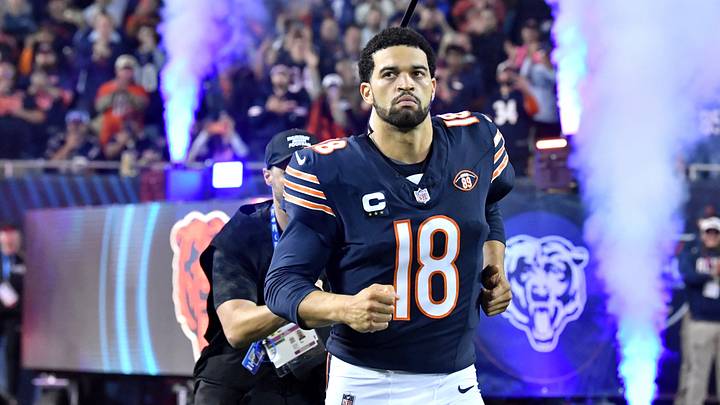
Caleb Williams has spent much of his young NFL career hearing about the things he needs to fix. His decision-making, accuracy and willingness to force throws have all come under scrutiny. Yet one statistic suggests the Chicago Bears quarterback might be doing something better than anyone realizes.
Williams is closing in on an NFL record currently held by Aaron Rodgers. And considering the criticism surrounding his play, it's probably not the record most people would expect.
Even after throwing four interceptions against the Tampa Bay Buccaneers, Williams has a lower career interception percentage than Rodgers, who sits atop the NFL's all-time leaderboard among qualifying quarterbacks.
The difference is small, but the implications are significant.
Caleb Williams is approaching rare territory
As first highlighted by Lester A. Wiltfong Jr. of Windy City Gridiron, Williams is approaching a remarkable distinction that would put him ahead of one of the greatest quarterbacks in NFL history.
Through 1,325 career passing attempts, Williams has thrown just 18 interceptions. That gives him a career interception percentage of 1.36%, slightly better than Rodgers' 1.42%.
Here's how the numbers compare:
- Caleb Williams: 1,325 attempts, 18 interceptions, 1.36%
- Aaron Rodgers: 9,060 attempts, 129 interceptions, 1.42%
- Jacoby Brissett: 1.53% career interception rate
- Tom Brady: 1.76% career interception rate
There's one catch. Williams hasn't attempted enough passes to qualify for the official career leaderboard.
The NFL requires at least 1,500 passing attempts, leaving Williams 175 attempts short of eligibility.
That puts him within reach of potentially taking the top spot before the season ends, provided he continues protecting the football.
Of course, Rodgers is still playing, meaning the number Williams is chasing isn't necessarily going to remain unchanged.
One ugly performance doesn't erase the bigger picture
Williams' four-interception outing against Tampa Bay wasn't pretty. There's no reason to pretend otherwise.
But it also demonstrated how quickly the conversation surrounding a quarterback can change.
One rough afternoon brought renewed questions about his judgment. Meanwhile, the larger sample suggests that throwing interceptions has rarely been a problem for Williams.
That's worth remembering when evaluating his development.
Avoiding interceptions doesn't automatically make someone an elite quarterback. Williams still needs to improve his consistency, recognize opportunities sooner and turn more possessions into points.
And comparing his interception percentage with Rodgers' doesn't mean he's accomplished anything close to what the veteran has achieved over two decades.
Still, the statistic deserves attention.
Rodgers has built much of his reputation around protecting the football. Brady, Patrick Mahomes and several other accomplished quarterbacks have higher career interception percentages.
Williams is currently ahead of all of them in that particular category.
The Bears have plenty of reasons to expect more from their young quarterback. But if Williams maintains his current pace, one of the NFL's most impressive passing records could soon belong to Chicago.
For a player whose decision-making has been questioned so often, that would be quite a statement.
 Add us as a preferred source on Google