

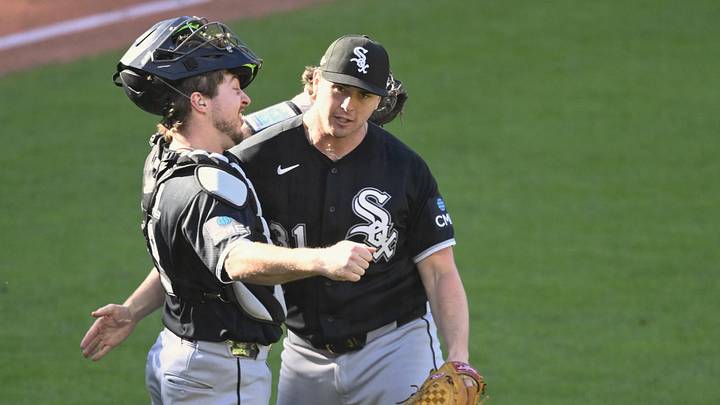
The formula for winning in October has been repeated for generations.
Get great starting pitching. Hand the ball to your ace. Ride him as long as possible, shorten the game with your bullpen and hope you have enough arms left to do it again a few days later.
Apparently, nobody bothered to tell the Chicago White Sox.
After shutting out the Cleveland Guardians 3-0 in Game 1 of the ALDS, Chicago is leaning even harder into a pitching strategy that looks completely backwards by traditional postseason standards.
And somehow, it's working.
White Sox don't seem interested in naming starters anymore
Hagen Smith technically started Game 1 against Cleveland.
Calling him a traditional starter would be stretching the definition.
Smith threw 2 2/3 innings before Will Venable started moving through his bullpen. Bryan Hudson recorded one out. Jordan Hicks got two. Anthony Kay handled another. Then Grant Taylor entered in the sixth and simply finished the game.
Five pitchers. Three hits allowed. Twelve strikeouts. Zero runs.
Taylor actually pitched more innings than Chicago's starter.
That used to be the type of sentence that meant something had gone horribly wrong.
For these White Sox, it was pretty much the plan.
Chicago keeps changing the question for opposing hitters
There's another benefit to this setup that gets lost when everything is reduced to the phrase "bullpen game."
Cleveland hitters never got comfortable.
Jo Adell probably explained it better than anyone after striking out four times. He described being "in a blender" because he kept seeing different pitchers and different looks.
That's exactly what Chicago is creating.
Instead of asking Smith to navigate the Guardians lineup two or three times, Venable can attack specific pockets of hitters and move on. A hitter adjusts to one delivery, velocity or pitch mix and then gets something completely different the next time he walks to the plate.
There's no third-time-through-the-order problem if nobody gets a third time.
The White Sox aren't abandoning the strategy now
Maybe the strangest part is that Game 1 wasn't some emergency maneuver.
The White Sox led the majors with 11 bullpen games during the regular season. Venable then used the approach to open the Wild Card Series against Houston.
Now they're doing it again.
Anthony Kay is set to open Game 2 against Cleveland. It will mark the 33rd time this season Chicago has used an opener and the third time during this postseason alone.
At some point, this stops looking unconventional and starts looking like an identity.
The postseason schedule helps. Off days give Venable opportunities to bring pitchers back sooner than he could during the grind of the regular season.
Roles become secondary. Matchups become everything.
Even Smith laughed when asked before Game 1 whether he considers himself a starter or reliever anymore.
"I'm just a pitcher at this point," Smith said.
That might as well be the motto for Chicago's entire staff.
October baseball isn't supposed to look like this
The White Sox don't have the kind of conventional postseason rotation teams spend years trying to assemble.
So they quit pretending they do.
Instead of forcing pitchers into traditional roles, Venable is using whatever combination gives Chicago the best chance to collect 27 outs.
Sometimes that means a starter throws fewer than three innings.
Sometimes it means your closer enters in the sixth and records a four-inning save, something only five other pitchers had done in the postseason since the save became an official statistic in 1969.
It shouldn't look normal.
For the White Sox, that's becoming the whole point.
Baseball spent decades teaching teams that October belongs to dominant starting pitchers.
Chicago is trying to find out what happens when you stop caring who starts and worry only about who gets the next out.
| More White Sox on DaWindyCity |
 Add us as a preferred source on Google