

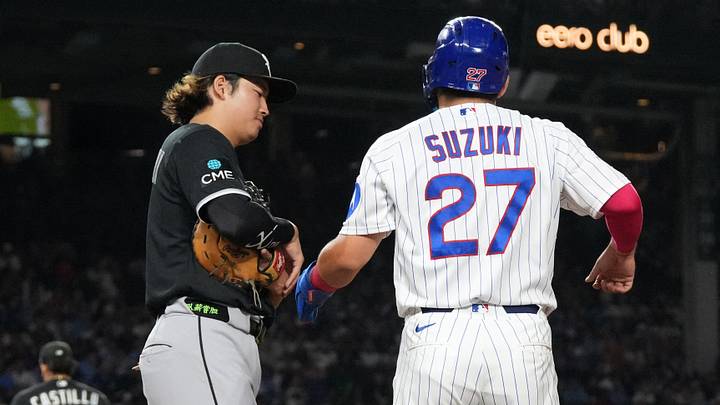
The idea of a Cubs-White Sox World Series normally belongs in the same category as Chicago having reasonable traffic or everyone agreeing on the best pizza.
This year, though, there is an actual statistical case to examine.
Both Chicago teams reached the 2026 postseason, with the Cubs finishing 89-73 and the White Sox 84-78. Neither enters October as a favorite to win its league, and both have to survive the Wild Card round just to reach a Division Series. Still, the regular-season numbers suggest this isn't simply two mediocre teams getting lucky at the same time.
The Cubs have the numbers of a serious contender
The Cubs were considerably better than its 89 wins suggest.
The Cubs scored an MLB-leading 850 runs while finishing first in slugging percentage and OPS and second in on-base percentage. They also hit 220 home runs. That's not an offense that barely crawled into October. It's one capable of carrying a team through a short series.
Run differential tells an even more interesting story.
The Cubs finished at plus-147, one of the strongest marks in baseball. Its expected record based on runs scored and allowed was roughly 95 wins, six better than its actual total. In other words, the Cubs performed more like a mid-90s-win team than the 89-73 record sitting next to their name.
There is one obvious problem.
The Cubs didn't receive a bye.
They must beat San Diego in a best-of-three series on the road before getting anywhere near the NLCS. Oddsmakers essentially view that opening series as a toss-up, with Chicago around even money to advance. The Cubs did go 5-1 against San Diego during the regular season, although October has a funny habit of laughing at six-game samples.
The White Sox aren't as overmatched as their seed suggests
The White Sox are the bigger long shot, but their underlying numbers make them fascinating.
They finished 84-78 with a positive run differential after scoring substantially more runs than they allowed. Their Pythagorean expected record was better than their actual record late in the season, another indication that this wasn't merely a team surviving on one-run wins and good fortune.
The offense was also above average. Baseball Reference's adjusted offensive numbers put the White Sox above league average, although well behind the Cubs' production. Their pitching staff allowed opponents to hit just .243, the same batting average surrendered by Cubs pitching.
The Astros won the AL West at just 81-81 and were outscored by 32 runs during the regular season. The White Sox won three more games and posted a dramatically better run differential, yet Houston gets home field and enters as the favorite because it won the division.
That's where the No. 6 seed becomes misleading.
The White Sox aren't exactly getting thrown to the wolves in the opening round, either. Houston finished 81-81. The Sox won 84 games and had the better run differential over a full season.
There is a catch. Houston beat the White Sox five times in seven tries this year. That's hard to ignore, especially in a three-game series where there isn't much time to recover from a bad afternoon. Still, the difference between these teams isn't nearly as large as their playoff seeds suggest.
What are the chances of an all-Chicago World Series?
Now for the fun part.
The Cubs entered the postseason at roughly +900 to win the National League pennant, depending on the sportsbook. The White Sox were sitting around +1100 to +1200 to come out of the American League.
Strip those odds down to implied probability and you're looking at roughly a 9 to 10 percent chance for the Cubs and about an 8 percent chance for the Sox.
Put the two together and an all-Chicago World Series comes out somewhere in the neighborhood of 0.7 to 0.8 percent.
Call it roughly one chance in 125 to 140.
That's a long shot. No way around it. It's also probably better than most people would guess after hearing the words "Cubs-White Sox World Series."
Both teams have to get through the Wild Card round first. The Cubs and Padres are close to a toss-up, while the Sox are underdogs against Houston. Survive those, and Chicago still isn't particularly close. Each team would need two more series wins to claim a pennant.
That's the part that crushes the percentage. It isn't asking the Cubs to pull one upset or the White Sox to get hot for a weekend. You're asking both teams to keep winning at the same time.
The numbers at least give Chicago a reason to dream
A one-percent chance doesn't sound particularly exciting until you consider what has already happened.
The Cubs finished with 89 wins and a plus-147 run differential. Their expected record based on runs scored and allowed was closer to a 95-win club. They weren't some fortunate Wild Card team that slipped into October because a few one-run games bounced their way.
The White Sox don't have that kind of statistical profile, but 84 wins and a positive run differential aren't nothing. More importantly, they open against an 81-win Houston team that was outscored over the course of the season.
Neither Chicago team needs a miracle to win its first series.
They just need to keep doing it.
That's why a Cubs-White Sox World Series is still a long shot, but not quite the punchline it would have been in plenty of other seasons. The math says somewhere around one chance in a hundred and change.
For something that hasn't happened since 1906, Chicago will take it.
| More Cubs and White Sox on DaWindyCity |
 Add us as a preferred source on Google