

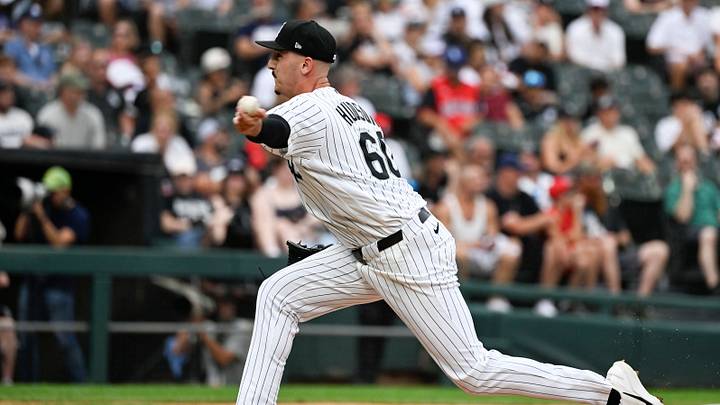
The Chicago White Sox have been through the gauntlet. So you'd think that when they hosted the Cincinnati Reds at home, after a day off, with their best pitcher of the past month or so starting the game, they'd win. Add in the giveaway of Pope hats, since the actual Pope is a Sox fan, and it seemed fait accompli.
And until the eighth inning, all was going according to plan. Then Bryan Hudson relieved White Sox starter Sean Burke, who'd been strong all day save for allowing a solo homer to Eugenio Suarez, and it all fell apart.
The White Sox collapse cannot be pinned on one reliever
Hudson will take a lot of the blame for what happened, but that would be a bit unfair. He did allow three straight hits before being removed, but the first two were just plain bad luck. Pinch hitter Matt McLain reached on an infield single and then Michael Toglia reached after White Sox second baseman Sam Antonacci couldn't chase down a popup that just missed his glove. An Elly De La Cruz single brought a run home, then Sal Stewart moved the runners over with a sacrifice fly before JJ Bleday walked and Tyler Stephenson singled them home to tie the game.
Grant Taylor was actually responsible for the sac fly, walk, and single, since he'd replaced Hudson. For those who absolve Hudson, since the first two singles were bad luck, then Taylor would make a good target, even though he came out for the top of the ninth and was nails.
But the bigger problem, in my opinion, was the offense. The Sox got their first three runs in the form of solo home runs from Brenton Doyle, Edgar Quero, and Miguel Vargas, and the fourth came from an Antonacci double that drove in Randall Grichuk.
From there, however, the bats went flat -- the Sox had only one baserunner off of the Reds' bullpen, not counting the extra-inning ghost runner. That runner was Sox slugger Munetaka Murakami, who doubled in the bottom of the eight with one out. He was the go-ahead run in a close game and he was left stranded.
The Sox couldn't even get the ghost runner to third in their half of the bottom of the 11th. Cincinnati, meanwhile, used two sacrifice flies to send their man home with the eventual winning run -- they scored a run while making three consecutive outs.
As an aside, I am souring on the ghost runner, at least as early as it's deployed. Perhaps it would be better to wait until later in extra innings. Not only does it make that a runner could score even with the fielding team making three consecutive outs, but it also means the home team is often chasing a run when coming to bat in the bottom of the 10th. I also noticed another issue during the wild series finale against the Boston Red Sox at Fenway Park last week. Every time the White Sox scored, the Red Sox matched, and the game kept going. The idea of the ghost runner is to end extra-inning contests sooner, but if the visitors score one and the home side matches, the game can just keep going.
Anyway, back to the White Sox. A lot of fans are down on the bullpen this morning, but I am more frustrated by an offense that seemed to take its foot off the gas with a four-run lead against a team that's not really in National League playoff contention. I've also noticed a boom-or-bust approach to White Sox hitting lately, especially when the team is trailing. Sox hitters seemed to be looking for the tying or winning home run instead of moving a run over with a base hit. Contrast that to Stephenson's game-tying single, which was a soft single into right field on a pitch that he couldn't do much else with.
Sam Antonacci gets some credit for a 14- or 15-pitch at-bat in the bottom of the 10th, but he still struck out swinging. Colson Montgomery has looked lost at the plate lately, in part because it seems like he's trying to launch every pitch to the right-field concourse.
Maybe Murakami comes home from second if Vargas and Grichuk don't fly out. Maybe the Sox tie the game and come back to win if they can move the ghost runner over in the 10th.
As a friend said to me this morning when I complained about the ghost runner: "The ghost runner scoring is a given." That may be true at lot of the time, but it wasn't for the White Sox last night and that is their own fault.
Cincinnati has played well since the All-Star break and the Reds do have two stars in Suarez and De La Cruz. They still have legendary manager Terry Francona. They aren't a pushover. But they aren't good, either. Not this year. And losing a winnable game against them while the Detroit Tigers are chasing you down for the AL Central division lead is inexcusable.
I wasn't necessarily requiring a sweep of the Reds -- two of three is fine, and still possible as I type this. It's not so much that the Sox lost the first game of the series, as how they lost. Even with Hudson and Taylor experiencing a nightmare inning, the game was tied at home and the Sox were facing a bullpen that doesn't scare anyone. Situational hitting was required -- and just one or two hits would've been enough. Instead, the Sox were unable to recover.
Bad luck happens in baseball. Solid relievers have bad nights. When you have a 4-0 lead against a mediocre team, at home, needing only six outs, and the game flips, you have to deal with it via your offense. Instead, the Sox managed to squander a double and the ghost runner -- as noted, that person almost automatically scores.
There's no reason to panic. The Sox have bounced back from bad losses -- and heartbreaking losses in well-played games -- all season. There's still a lot of season left, and 2026 has been the year of streaky teams. Just look at Boston losing four straight after a historic heater, or the crosstown Chicago Cubs' streakiness. Detroit has been playing well after a bad start to the season, but there's no guarantee that will last.
So if the Sox can take two of three against Cincinnati, they can then aim to take two of three or even sweep the Tigers in their next series. But they've made the first part of that task a little harder.
Every winning baseball team, even champions, have bad losses. The prohibitive favorite, the Los Angeles Dodgers, have gone through a bad stretch recently. But competitive teams need to win games like last night's. The loss is survivable in the grand scheme of things, but losses like that make the work ahead harder at best and at worst can come back to haunt you during a close pennant race.
The White Sox need to improve situational hitting -- and need to learn how to close out games like that. There will be other games against inferior competition between now and the end of the regular season -- and if the Sox have a multi-run lead late, they must make sure those contests end in a W.
| More White Sox News and Rumors |
 Add us as a preferred source on Google