

Nine NFL championships. One Super Bowl victory. More legendary linebackers than most franchises could dream of having.
Chicago's history at the quarterback position has produced some interesting debates. Jim McMahon won a Super Bowl without putting up extraordinary passing numbers. Jay Cutler broke franchise records but never reached the big game. Caleb Williams has already done things previous Bears quarterbacks couldn't, although his career is still in its early stages.
Rankings are subjective, especially when comparing players who competed under completely different rules. Championships, individual statistics, longevity and each quarterback's contribution to the Bears all factor into this list.
5. Erik Kramer (1994–1998)
Erik Kramer probably wouldn't appear on many all-time quarterback lists outside Chicago. His 1995 season, though, was something Bears fans hadn't seen before.
He threw for 3,838 yards and 29 touchdowns with just 10 interceptions. Chicago finished 9-7 and missed the playoffs despite getting that kind of production from its quarterback.
For perspective, Kramer's touchdown record stood for 30 years.
Unfortunately, his body didn't cooperate when it came time to build on that performance. Injuries limited him to eight starts in 1996, and although he returned the following season, the Bears never got another year quite like 1995.
Billy Wade deserves consideration here. He helped Chicago win the 1963 NFL championship, an accomplishment Kramer couldn't match. Jim Harbaugh also spent considerably more time with the organization.
Kramer's argument rests primarily on one exceptional season. In a franchise with relatively few outstanding passing seasons, that's enough to earn consideration for the fifth spot.
4. Caleb Williams (2024–present)
Caleb Williams is the most difficult quarterback to place on this list. Not because he lacks talent, but because his career is still being written.
His 2025 season provided a pretty compelling argument for inclusion.
Williams threw for 3,942 yards, breaking Chicago's single-season passing record, and helped the Bears return to the playoffs under Ben Johnson. For a franchise that had spent years searching for a long-term answer at quarterback, his second season offered tangible progress.
His ability to improvise is particularly valuable. Williams can escape pressure, extend plays and deliver throws from angles that would be difficult for most quarterbacks to attempt.
That same approach occasionally gets him into trouble. Holding the ball in pursuit of a bigger play can turn an ordinary incompletion into a sack.
Williams still has plenty to establish before his career can be compared fairly with players who spent years in Chicago. His early 2026 injury also presents another obstacle.
Nevertheless, a franchise passing record and a postseason appearance in his second season give him a place in this conversation.
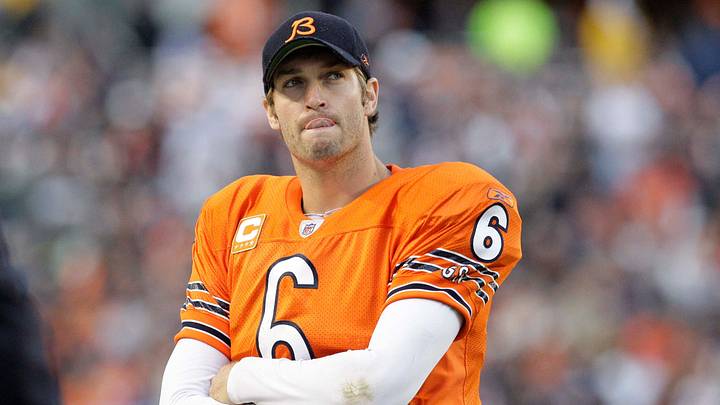
3. Jay Cutler (2009–2016)
Jay Cutler could throw a football through a window most quarterbacks wouldn't even notice. Unfortunately, he sometimes tried doing it when three defenders were standing in front of that window.
That was the trade-off Chicago lived with for eight seasons.
Cutler arrived from Denver in 2009 with enormous expectations. The Bears had finally acquired a quarterback with the arm strength to open up their offense, and they paid a substantial price to get him.
What followed was a mixture of terrific throws, maddening interceptions and enough coaching changes to make developing any sort of offensive identity difficult.
Cutler finished his Bears career with 23,443 passing yards and 154 touchdowns, both franchise records. He also led Chicago to the NFC Championship Game following the 2010 season, where a knee injury ended his afternoon against Green Bay.
His detractors have plenty of ammunition. Cutler could be careless with the football, and some of his worst performances came when the Bears needed him most.
But dismissing his entire Chicago career because he never won a championship ignores eight seasons of production. The Bears had struggled to find a quarterback capable of consistently attacking defenses downfield before Cutler arrived. They struggled to replace him after he left.
His tenure wasn't the success Chicago envisioned when it made that blockbuster trade. It was still one of the most productive quarterback careers the franchise has ever seen.
2. Jim McMahon (1982–1988)
The 1985 Bears could beat opponents in just about any fashion imaginable. Their defense terrorized quarterbacks, Walter Payton punished defenders, and Jim McMahon seemed to spend half his time finding new ways to irritate Mike Ditka.
It was a pretty effective arrangement.
McMahon's statistical résumé doesn't resemble Cutler's. He finished his Bears career with 11,203 passing yards and 67 touchdowns, with injuries repeatedly interrupting his time on the field.
But reducing him to the quarterback who happened to play alongside an extraordinary defense misses what he brought to Chicago.
McMahon could scramble, improvise and make plays when defenses concentrated on stopping Payton. He wasn't particularly interested in playing conservatively simply because his defense could protect a lead.
His personality fit the team, too. The 1985 Bears weren't exactly a quiet, businesslike group, and their quarterback was often at the center of the spectacle.
Chicago went 15-1 that season before dismantling New England 46-10 in Super Bowl XX.
There's room to debate how much credit McMahon deserves for that championship. There's considerably less room to dispute how well his approach worked with the players surrounding him.
The Bears have had quarterbacks with stronger arms and better passing statistics. McMahon remains the only one who has led Chicago to a Super Bowl victory.
1. Sid Luckman (1939–1950)
Sid Luckman threw seven touchdown passes against the New York Giants in 1943. Consider how difficult that is today, with offenses specifically designed to produce enormous passing numbers.
Now imagine doing it in the 1940s.
Luckman wasn't merely taking advantage of an innovative offense. His ability to operate George Halas' T-formation was a major reason the system worked so well. Chicago's passing attack forced defenses to deal with problems that many teams simply weren't equipped to handle.
The championships followed.
Luckman led the Bears to four NFL titles in 1940, 1941, 1943 and 1946. His 1943 campaign included 28 touchdown passes in just 10 games and the league's MVP award.
He finished his career with 14,686 passing yards and 137 touchdowns before entering the Pro Football Hall of Fame in 1965.
Those totals don't look extraordinary beside modern quarterback statistics. They weren't accumulated in anything resembling the modern NFL, either. Luckman played when teams relied heavily on their running games, and throwing the football was a much smaller part of the typical offensive game plan.
His influence went beyond Chicago's championship trophies. The success of the Bears' T-formation helped change how other teams approached offensive football.
McMahon delivered the franchise's only Super Bowl championship. Cutler owns its career passing records, and Williams has already broken its single-season yardage mark.
Luckman combined individual production, four championships and a lasting influence on the sport. More than 75 years after his retirement, his accomplishments remain the benchmark for quarterbacks in Chicago.
| More Bears on DaWindyCity |
 Add us as a preferred source on Google