

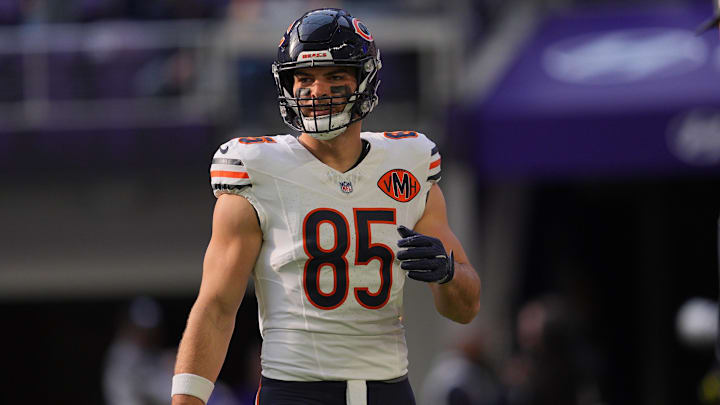
Chicago Bears tight end Cole Kmet went from being a potential trade deadline candidate during the season to re-solidifying himself as an option within Ben Johnson’s offense.
Last season was an adjustment for Kmet, who went from being the TE1 to the TE2 with Colston Loveland’s emergence. Kmet had 30 receptions (48 targets) for 347 yards and two touchdowns, which is a significant step down from what he accomplished in 2024 – 47 receptions (55 targets) for 474 yards and four TDs.
However, when the Bears needed someone to step up in the playoffs, Kmet answered the call. He had three receptions (three targets) for 31 yards and the game-tying touchdown against the Los Angeles Rams in the divisional round. While Chicago's season came to an end that night, Kmet may have bought himself new life with the Bears as a result.
With that in the backdrop, Kmet could have a bigger role in the Windy City this upcoming season, thanks to a couple of changes on offense. Those changes were the D.J. Moore trade and not having a bona fide WR3.
Kmet Has a Perfect Chance to Re-Establish Himself In the Bears’ Offense
When the Bears traded Moore to the Buffalo Bills earlier this month, it immediately changed their depth chart at the WR position. Rome Odunze and Luther Burden III moved up to the WR1 and WR2 spots and will likely see an uptick in targets, as the Bears will have to replace Moore’s 85 targets.
However, those two won’t take up all the targets. Kmet will likely factor into the picture, along with Loveland, and whoever is the Bears’ WR3. That spot at receiver for Chicago is not quite set in stone just yet, as it was last year with Olamide Zaccheaus.
This season, it will be veteran Kalif Raymond and Jahdae Walker battling it out for WR3 duties in the Windy City, and trying to fill the 65 targets left behind by Zaccheaus.
Overall, Chicago will have to find a way to fill 150 total targets lost with the departures of Moore and Zaccheaus, which bodes well for Kmet. Before Loveland arrived, Kmet was the primary option at TE for Chicago for four years, where he averaged 76.8 targets per season.
He likely won’t reach that mark with Loveland continuing his development, but there’s no reason to think that he can’t get 55-60 targets with 35-40 receptions. If that were to happen, the Bears’ offense should be one of the best in the league this upcoming season.
Last season, the Bears ranked sixth in 12 personnel usage at 32.64 percent, which is higher than the league average of 22.33 percent, according to Sumer Sports. For those unfamiliar with the term, 12 personnel is a scheme including one RB, two TEs, two WRs, along with the starting QB and starting offensive line. Before Johnson arrived in Chicago, the Bears were ranked 19th in personnel usage in 2024 (19.34 percent) under Matt Eberflus.
If they stick at that same rate or go higher because of the lack of a true WR3, Kmet's opportunities should improve. Defenses won’t know if a pass is coming or if it's a run play, especially with the success that Chicago had on the ground last season with D’Andre Swift and Kyle Monangai.
More Chicago Bears News and Rumors:
 Add us as a preferred source on Google