

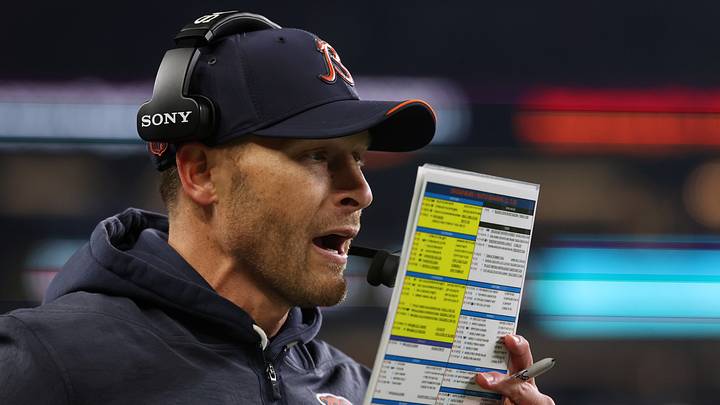
The Chicago Bears have won games in just about every imaginable fashion over the years, including a few they probably had no business winning. Monday night in Seattle was different.
Ben Johnson didn't need Caleb Williams to perform a magic trick. He didn't need a defensive touchdown or some miraculous sequence in the final two minutes. Chicago walked into Seattle, punched the defending Super Bowl champions in the mouth and spent most of the night making them play catch-up.
The 34-17 final score was impressive. What Johnson accomplished with his offense was considerably more revealing.
Ben Johnson made Seattle play Chicago's game
The Seahawks hadn't surrendered an opening drive touchdown in 27 games. That streak lasted all of eight minutes and 32 seconds against Chicago.
Seventeen plays covering 80 yards.
Think about how frustrating that must have been for Seattle. Its defense thrives on creating uncomfortable situations, forcing quarterbacks into obvious passing downs and letting the pass rush take over.
Johnson essentially told the Seahawks they weren't getting those opportunities.
Williams completed eight of 10 passes on that opening possession. Nothing particularly outrageous. Just completions that kept the chains moving and prevented Seattle from getting its defense off the field.
And that's precisely what made the drive impressive.
How many times have Bears fans watched an offense pick up a couple of first downs, only to have everything fall apart because somebody took an unnecessary sack or tried forcing a throw that wasn't there?
Johnson has spent months trying to eliminate those mistakes.
Monday night offered perhaps the clearest evidence yet that his message is getting through.
The Bears weren't interested in matching Seattle's physicality for a possession or two. They wanted to make the Seahawks defend the entire field, over and over again.
By the time Seattle's offense finally took the field, Chicago had already established exactly how it planned to attack.
"I want to make these fans extremely proud to be a Bears fan."
— SportsCenter (@SportsCenter) November 3, 2026
Caleb Williams joins @notthefakeSVP and is welcomed by a crowd of Bears fans following their win on the road against the Seahawks 😤 pic.twitter.com/ntWXe10y2w
The Bears faced their familiar fourth quarter nightmare
Of course, it wouldn't be a Bears game without at least one moment that made Chicago fans question their blood pressure medication.
Colston Loveland's fourth quarter fumble gave Seattle new life. The Seahawks scored, cutting Chicago's lead to 20-17.
Suddenly, an impressive road performance was one bad possession away from becoming another miserable flight home.
This is where Johnson deserves considerable credit.
He didn't start coaching like a man terrified of losing.
Chicago responded with another touchdown, refusing to let Seattle dictate what happened next. There was no dramatic offensive reinvention or desperate attempt to manufacture something that hadn't worked all night.
The Bears trusted what had gotten them there.
That sounds ridiculously simple, but anyone who has followed this franchise knows how often Chicago has struggled with that concept.
Too many previous Bears teams treated a narrow fourth quarter lead like something fragile. Protect the football, run out the clock and pray the defense can finish the job.
Johnson wanted to score again.
There's a pretty substantial difference between those two approaches.
Chicago's offense is finally making life easier on its defense
Williams finished with 247 passing yards and no turnovers. He was sacked once. D'Andre Swift scored three rushing touchdowns.
Meanwhile, Seattle managed just 252 total yards and converted one of its 11 third down attempts.
Those numbers aren't unrelated.
When an offense sustains possessions, the defense gets a chance to rest. When the defense forces punts, the offense gets more opportunities to operate without feeling like every possession must produce points.
For years, Chicago has struggled to get those two units working together consistently.
Johnson appears to be changing that.
And while Jeffery Simmons deserves plenty of recognition for his performance, the Bears' success wasn't dependent on one defensive newcomer dominating the game.
Chicago played complementary football against an opponent that has made a habit of punishing teams that can't.
Nobody should confuse one impressive Monday night performance with proof that the Bears have solved every problem. There will be games when Williams struggles, the running game disappears or Johnson makes a questionable decision.
But at 6-2, Chicago is beginning to look considerably different from the team that once needed everything to go perfectly just to beat a quality opponent.
The Bears made mistakes Monday. They gave Seattle opportunities to get back into the game.
And they still won by 17.
That's what should have the rest of the NFC paying attention.
For once, Chicago didn't spend the evening figuring out how to survive somebody else's game plan.
Seattle spent the evening dealing with Chicago's.
 Add us as a preferred source on Google