

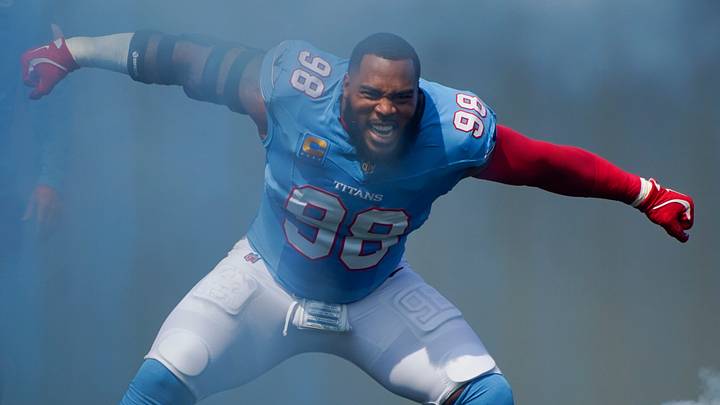
The Chicago Bears wanted to make a statement, and Ryan Poles certainly accomplished that by acquiring Jeffery Simmons from the Tennessee Titans.
Nobody should question whether Simmons makes the Bears better. He does. Chicago landed one of the NFL's premier defensive tackles, a player capable of disrupting an offense without needing much help.
But there's another question worth asking before celebrating the deal.
Was Simmons the best option available, particularly considering what Chicago gave up to get him?
The Bears had other possibilities, including DeForest Buckner, who ultimately landed with the San Francisco 49ers. Chicago didn't get him, and now the organization has committed significant draft capital to Simmons.
That doesn't make the trade a mistake. It does make the decision worth examining.
Bears paid a significant price to acquire Jeffery Simmons
Chicago surrendered its 2027 and 2028 first-round picks, along with a 2027 fourth-round selection, in exchange for Simmons and a 2028 fifth-round pick.
That's a substantial investment for any player outside the quarterback position.
Simmons is 29 and coming off an outstanding 2025 season in which he recorded 11 sacks. He's already produced four sacks through seven games this year, and his ability to generate pressure from the interior should give Chicago something it has desperately needed.
There's also a benefit that won't necessarily appear on his stat sheet.
Opposing offensive coordinators must account for Simmons on every snap. Double teams become necessary, protection assignments change, and defensive ends can benefit from the attention he commands.
Montez Sweat could be among the biggest beneficiaries.
For defensive coordinator Dennis Allen, Simmons provides another way to generate pressure without constantly sending additional defenders.
It's easy to understand why Poles wanted him.
But understanding the attraction doesn't automatically justify the price.
Bears missed another opportunity when 49ers acquired DeForest Buckner
Before Simmons arrived in Chicago, DeForest Buckner was another name connected to the Bears.
The former Indianapolis Colts defensive tackle ultimately went to San Francisco, where he previously spent the first four seasons of his career.
That left Chicago without one of the more intriguing alternatives on the market.
Buckner is older than Simmons, which certainly factors into the equation. Simmons offers a longer potential window of high-level production, and that's something Poles had to consider.
Still, the Bears reportedly had interest in Buckner, and San Francisco managed to complete a deal before Chicago landed its defensive tackle.
Did the Bears wait too long? Was Indianapolis asking for more than Poles wanted to surrender? Or was Simmons the preferred option all along?
We don't know.
What we do know is that Chicago eventually parted with two first-round selections to address the position.
And that raises another possibility. Could the Bears have acquired a less expensive defensive tackle and used the remaining resources to strengthen another area of the roster?
It's a fair question, especially with Caleb Williams still developing and the organization looking to build something sustainable around him.
Jeffery Simmons could still prove to be exactly what the Bears needed
There's a temptation to judge trades immediately, particularly when multiple first-round picks are involved.
But Chicago didn't acquire Simmons to win an argument about trade value in October.
The Bears are 5-2. They have an offense showing promise under Ben Johnson, and the addition of an elite interior defender could help them compete with the NFC's better teams.
If Simmons transforms Chicago's defensive front and helps the Bears make a deep playoff run, nobody will spend much time complaining about the draft picks.
On the other hand, those selections could become valuable resources as Williams approaches the more expensive years of his career.
That's the gamble Poles accepted.
The Bears didn't acquire a developmental prospect or an aging veteran hoping for one final productive season. They acquired a proven difference maker who should improve their defense immediately.
There's plenty to like about that.
But the best player isn't always the best acquisition when the cost of obtaining him enters the conversation.
Maybe Simmons was worth paying considerably more than the other available options. Maybe Buckner would have provided enough production at a lower price, allowing Chicago to address another weakness.
For now, both arguments deserve consideration.
The Bears got better with Simmons. Whether they made the smartest possible move is a question that won't be answered this week.
Time will tell.
| More Bears on DaWindyCity |
 Add us as a preferred source on Google